

We tend to focus on life’s big decisions, but it’s often the small, everyday choices that quietly shape our direction. This article explores how defaults, habits, and seemingly insignificant decisions influence our productivity, behavior, and long-term outcomes. By becoming more intentional about the small decisions we make each day, we can create meaningful changes that compound over time and steer our lives in a better direction.
“Great things are done by a series of small things brought together.”
— Vincent van Gogh
Have you ever looked at an area of your life—your career, relationships, health, finances, or even the way you spend your days—and wondered, How did I end up here?
Usually, there wasn’t one defining moment that brought you to where you are. There was no dramatic fork in the road or single decision that changed everything. More often, you arrived gradually, through choices that seemed relatively insignificant at the time.
We tend to reserve our attention for life’s big decisions: Should I take this job? Should I move? Should I marry this person? Should I start a business? These choices undoubtedly matter.
But between those major crossroads are hundreds of smaller decisions about how we spend our time, what we pay attention to, which relationships we nurture, what we practice, what we tolerate, and what we repeatedly postpone.
I was reminded of this recently while reading Jim Collins’s What to Make of a Life, a fascinating exploration of how people navigate the twists, transitions, and turning points that shape a lifetime.
As I read their stories, something struck me. The arc of a life was not always determined by one monumental decision. Often, it was a series of seemingly small choices—taking an unexpected opportunity, pursuing an interest, walking away from something that no longer fit, following a curiosity—that gradually moved someone toward a different future.
Perhaps it was easier to see because I was looking at someone else’s life.
When we view another person’s story from beginning to end, we have the benefit of perspective. We can trace the thread backward and see how one choice led to another. We notice the detours that became opportunities and the seemingly insignificant moments that, in retrospect, changed everything.
But when we are living our own lives, we can’t always see the forest for the trees. We are immersed in today’s deadlines, conversations, frustrations, errands, and decisions. The choice in front of us can seem too small to matter.
Think of an airplane traveling toward a distant destination. A tiny change in its course may seem negligible shortly after takeoff. But maintain that altered trajectory over thousands of miles, and the plane can eventually arrive somewhere very different from where it intended to land.
Our lives can unfold in much the same way.
A single late night, impulse purchase, skipped workout, difficult conversation, hour spent learning, or decision to call someone is unlikely to transform your future. But when small decisions become patterns, their effects compound.
Years later, we may look around and wonder, How did I get here? without realizing that the destination was shaped, in part, by countless choices that once seemed inconsequential.
This doesn’t mean we should agonize over every decision. We need cognitive shortcuts, routines, and habits simply to function without exhausting ourselves. But perhaps we do need a compass—a framework that helps our recurring choices point broadly in the direction we want to travel.
That compass begins with knowing ourselves: understanding our values, recognizing what matters to us, and developing a vision for the kind of life we want to create. When we have a clearer sense of where we’re going, even our smallest decisions can begin to work together rather than pull us in competing directions.
Because ultimately, the question isn’t whether every small decision is important. It’s whether the small decisions we make repeatedly are taking us somewhere we actually want to go.

Why Small Decisions Matter More Than We Think
When we think about the choices that shape our lives, our minds naturally gravitate toward the big ones: which career to pursue, where to live, whom to marry, whether to start a business. Yet many outcomes are also built through choices so small that they barely register as decisions.
Consider the difference between reading ten pages of a book and scrolling through your phone before bed. On any given evening, neither choice is likely to change your life. But repeat one most nights for several years and the effects begin to diverge. One path might expose you to hundreds of books and new ideas; the other could quietly consume thousands of hours.
This is the power of accumulation. Small decisions rarely produce dramatic consequences in the moment, which is precisely why they are easy to underestimate.
In Atomic Habits, author James Clear captures this idea with the phrase, “Habits are the compound interest of self-improvement.” Just as money compounds gradually, the consequences of repeated choices can accumulate in ways that are difficult to see from day to day.
Imagine two colleagues who begin their careers in roughly the same place. One spends fifteen minutes each morning reading about developments in her industry. The other uses that time to browse social media. After a few months, the difference may be imperceptible. But over ten years, one has accumulated hundreds of hours of knowledge that could influence her ideas, decisions, and opportunities.
The same principle can work against us. Regularly spending a little more than intended, postponing difficult conversations, or sacrificing half an hour of sleep can appear harmless in isolation. Their significance lies in the direction they establish.
That doesn’t mean every small decision deserves scrutiny. Life would become exhausting if we treated every dessert, missed workout, or unproductive afternoon as consequential. The decisions worth noticing are the ones that repeat.
A better question is not “Will this one choice change my life?” but “Where will choices like this take me if they become my usual way of living?”
The Decisions You’ve Already Made Without Realizing It
There is another complication: many of our small decisions don’t feel like decisions at all.
Think about the first few minutes after you wake up. Your phone is charging beside your bed. You reach for it, see a notification, check a message, and soon find yourself scrolling through social media. It may feel like a series of choices. But one earlier choice—keeping the phone within reach—made the entire sequence more likely.
Behavioral economists call this the power of defaults: options that take effect when we don’t actively choose something different.
One of the clearest demonstrations comes from retirement savings. Research examining employees at large U.S. companies found that when workers were automatically enrolled in 401(k) plans while retaining the freedom to opt out, participation exceeded 85 percent.
Many also remained with the contribution rate and investment option selected for them by default. Simply changing what happened when people did nothing substantially changed their financial behavior.
The implications extend far beyond retirement accounts.
The snacks displayed on your kitchen counter, notifications automatically enabled on your phone, or the television you switch on after dinner can all function as informal defaults. None forces you to behave a certain way. They simply make one choice easier than another.
In Nudge, behavioral economists Richard Thaler and Cass Sunstein describe our tendency to stick with preselected options and the status quo, cautioning readers to “never underestimate the power of inertia.”
This helps explain why relying exclusively on willpower can be frustrating. We may be trying to make better small decisions while living in an environment designed to make the opposite decisions effortless.
Instead of asking, How can I become disciplined enough to make the right choice?, ask, What choice does my environment currently make easiest?
Someone who wants to read more might leave a book on the bedside table and charge their phone across the room. Someone who wants to save might automate a transfer on payday. Someone who wants uninterrupted time to write might disable notifications before beginning rather than resisting each one as it arrives.
The goal isn’t to remove choice. It’s to recognize that our surroundings are already influencing our choices, and become more deliberate about the direction in which they nudge us.
The Ripple Effect: How One Choice Influences the Next

Small decisions don’t always remain isolated. One choice can alter the conditions in which we make the next, creating a ripple effect across an entire day.
Imagine staying up an hour later than planned to watch another episode of a show. The immediate consequence seems minor. But you wake up tired, skip your morning workout, reach for something sugary for energy, struggle to concentrate in the afternoon, and decide you’re too exhausted to cook dinner. None of these outcomes was inevitable, but the first decision changed the likelihood of those that followed.
Researchers have observed similar patterns in what psychologists call behavioral spillover—when engaging in one behavior influences subsequent behaviors. The effect can work in either direction: one positive action may encourage another, while under some circumstances people may feel that an earlier “good” choice gives them permission to indulge later.
This is why some small decisions carry more weight than others. They sit near the beginning of a chain.
A morning walk, for example, might improve your mood, which makes you more patient at work, which changes how you handle a difficult conversation. Preparing lunch the night before may make nutritious eating easier the following day and prevent an afternoon energy crash. Beginning the morning without email might protect the first hour for concentrated work rather than allowing other people’s priorities to dictate your attention.
These are high-leverage decisions: relatively small choices capable of influencing several others.
Rather than trying to make every decision perfectly, it can be more useful to identify the few choices that consistently affect what happens next. Ask yourself: Which small decisions tend to set the tone for the rest of my day?
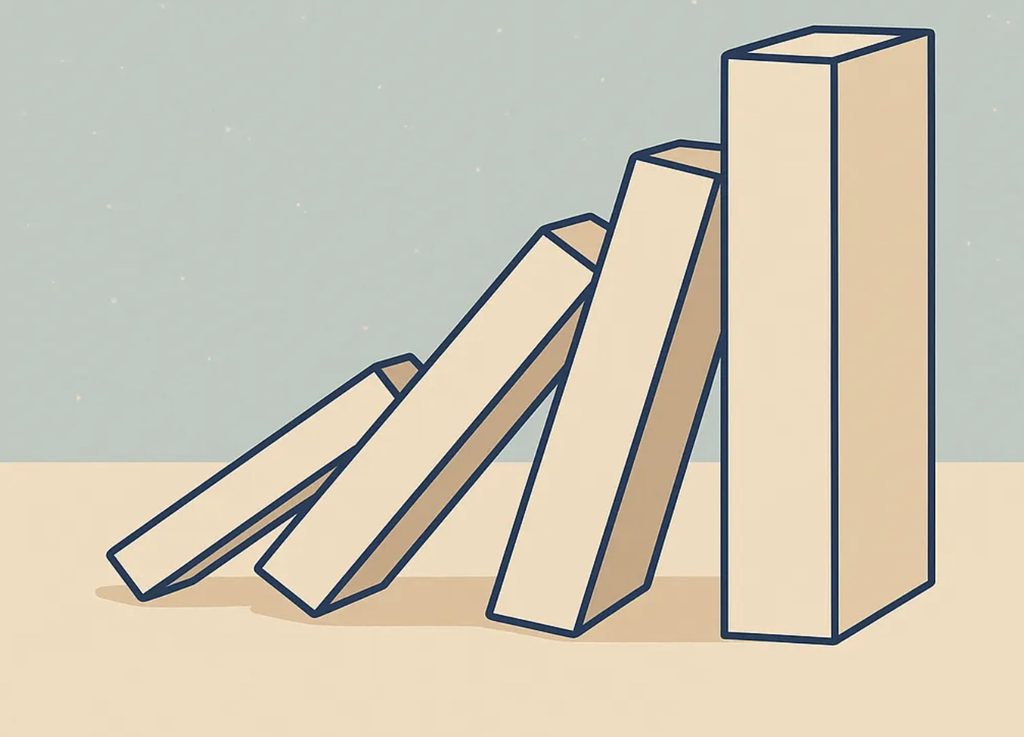
Sometimes changing the trajectory of a day doesn’t require changing everything. It requires changing the first domino.
How Small Decisions Shape Who You Become
The cumulative effect of small decisions isn’t limited to what we accomplish. Over time, our choices can also influence how we see ourselves.
Psychologist Daryl Bem’s self-perception theory proposed that we sometimes infer our own attitudes by observing our behavior, much as we might infer another person’s attitudes by watching what they repeatedly do. In other words, our actions don’t merely reflect who we think we are; under certain circumstances, they can help inform that perception.
Consider someone who wants to become a writer. Writing for twenty minutes one morning produces very little—a few paragraphs, perhaps. But repeatedly choosing to write provides something beyond words on a page: evidence. I am someone who writes.
The same process can unfold elsewhere. Keeping a promise to yourself can reinforce a sense of reliability. Speaking up when you would normally remain silent can provide evidence of courage. Choosing to learn something difficult instead of abandoning it at the first sign of frustration can gradually alter your perception of what you’re capable of.
This doesn’t mean every action reveals some deeper truth about our character. Missing a workout doesn’t make you undisciplined, and procrastinating one afternoon doesn’t make you lazy. Identity is far more complex than a tally of good and bad behaviors.
What matters is the pattern.
Stanford psychologist Albert Bandura’s research on self-efficacy similarly emphasized the importance of “mastery experiences”—experiences of successfully performing a task—in developing our belief that we can handle future challenges. Small wins can therefore matter partly because they give us something concrete to draw upon the next time we doubt ourselves.
Perhaps this is one of the most overlooked consequences of our small decisions: every repeated choice doesn’t just move us toward an outcome. It can steadily influence the story we tell ourselves about who we are becoming.
6 Ways to Make Better Small Decisions Every Day

Understanding the power of small decisions is useful, but the goal isn’t to scrutinize every choice you make. Instead, focus on the recurring decisions that have an outsized effect on your time, energy, and direction. Here are six ways to make those choices work in your favor:
1. Find your high-leverage decisions.
Pay attention to choices that tend to trigger others. Perhaps exercising in the morning improves your concentration all day, or checking email first thing sends you into reactive mode. Identify the few decisions that reliably create a ripple effect and prioritize those.
2. Create better defaults.
Make the choice you want to make the easiest one available. Put fruit somewhere visible, leave your book beside your bed, schedule recurring savings, or prepare your workout clothes the night before. Good defaults reduce how often you have to rely on motivation.
3. Add friction to choices you want to make less often.
The reverse works too. Behavioral scientists sometimes refer to these small obstacles as friction costs: even minor inconveniences can affect whether we follow through. Log out of distracting websites, remove shopping apps from your phone, or keep treats somewhere inconvenient. A few extra steps create a moment in which you can reconsider an automatic choice.
4. Automate what doesn’t deserve your attention.
Not every decision benefits from deliberation. Automate recurring bills and savings, establish a few reliable meals, schedule regular workouts, or create routines for repetitive work. Save your mental energy for decisions that genuinely require judgment.
5. Ask what you’re making easier for your future self.
Before a small choice, consider its downstream effect. Preparing something tonight, sending the email now, or spending ten minutes organizing your workspace may make tomorrow noticeably easier. Productivity often involves reducing future friction, not merely completing more tasks today.
6. Think in trajectories, not perfect days.
One late night, missed workout, impulse purchase, or wasted afternoon rarely determines anything. What matters is the direction created by repetition. Instead of asking whether you made every decision “correctly,” periodically ask: Are my recurring choices taking me where I want to go?
The aim isn’t to control every detail of your life. It’s to recognize the handful of small decisions that repeatedly influence everything around them, and make those choices a little more intentional.
A meaningful life is rarely shaped in one sweeping gesture. It is built through ordinary moments when no one is watching and nothing feels particularly significant.
Think of your small decisions as seeds. What you plant today may seem insignificant, and you may see no immediate evidence that anything is changing. But what you consistently plant, nourish, and tend eventually becomes the garden you live in.
You don’t need to make every choice perfectly. You simply need to become more conscious of what you’re cultivating and whether it reflects the life you want to create.
Your life is being shaped every day. And that may be the beautiful part: each new day brings countless opportunities to choose what you cultivate, shape what comes next, and make the most of the power you have.
All my best on your journey,
Seline

Question for you: What small decisions are you making every day that may be slowly shaping the person, and life, you’re becoming?

Have Your Say